

A half-hearted “sorry” won’t cut it anymore—here’s how to upgrade your apology game before you wreck your friendships, fumble your relationship, or lose your job.
So… Are You Actually Sorry, or Just Saying It?
We’ve all been there. That awkward pause after you’ve said, “I’m sorry.” You hold your breath, waiting to see if it landed or if the person across from you is still side-eyeing you like you forgot their birthday and stepped on their white sneakers. Apologies should be simple, right? Say the words, keep it moving. But if that’s how you’re treating it, then your relationships might already be hanging by a thread—and you don’t even know it.
In a world where ghosting is normal and accountability feels optional, learning to apologize with intention isn’t just some soft-skill fluff—it’s survival. Emotional survival. Relational survival. Career survival. Because here’s the truth: if you can’t own your stuff, you will lose people who matter.

Let’s break down why your apology probably sucks—and how to fix it before you burn every bridge you cros⁵s.
Apology Inflation: When “Sorry” Becomes Meaningless
We say “sorry” for everything. For sneezing. For disagreeing. For not texting back in five minutes. And somewhere in the mess of over-apologizing for existing and under-apologizing for actually hurting people, the word sorry lost its power.
According to psychologist Dr. Harriet Lerner (author of Why Won’t You Apologize?), most people don’t know how to apologize well because they confuse discomfort with accountability. “We’re afraid to admit fault,” she says, “because we think it makes us look weak or opens us up to blame.” But a real apology doesn’t shrink you. It grows you—if you do it right.
The Anatomy of a Trash Apology
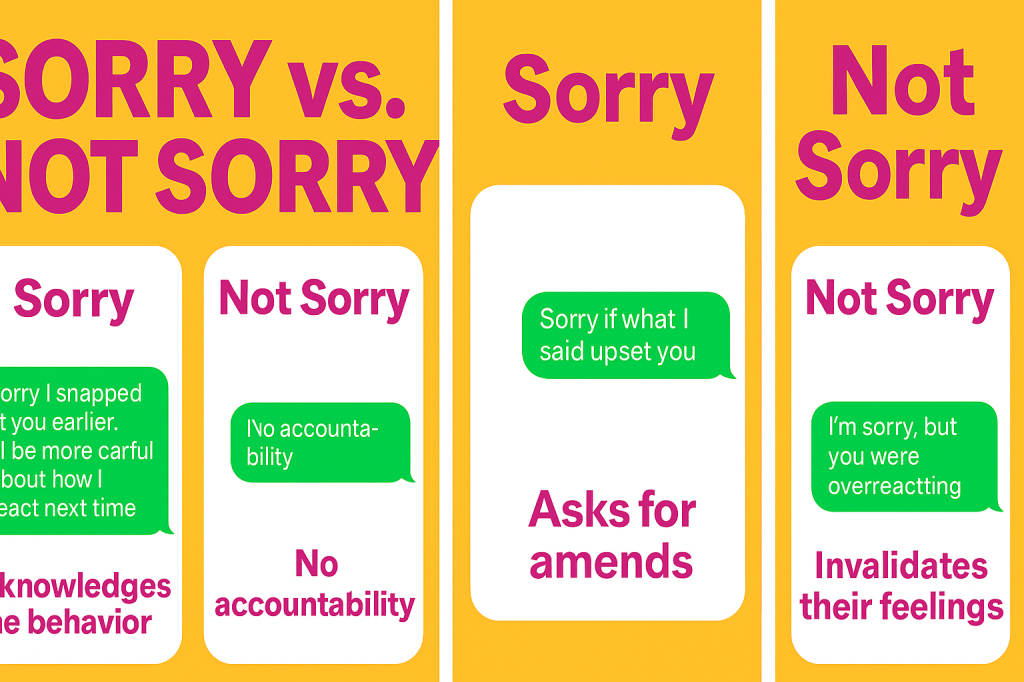
You know the ones. The non-apologies. The “sorry if you felt that way” or “sorry, but…” gems that somehow make things worse than if you’d said nothing at all. Here’s what bad apologies usually include:
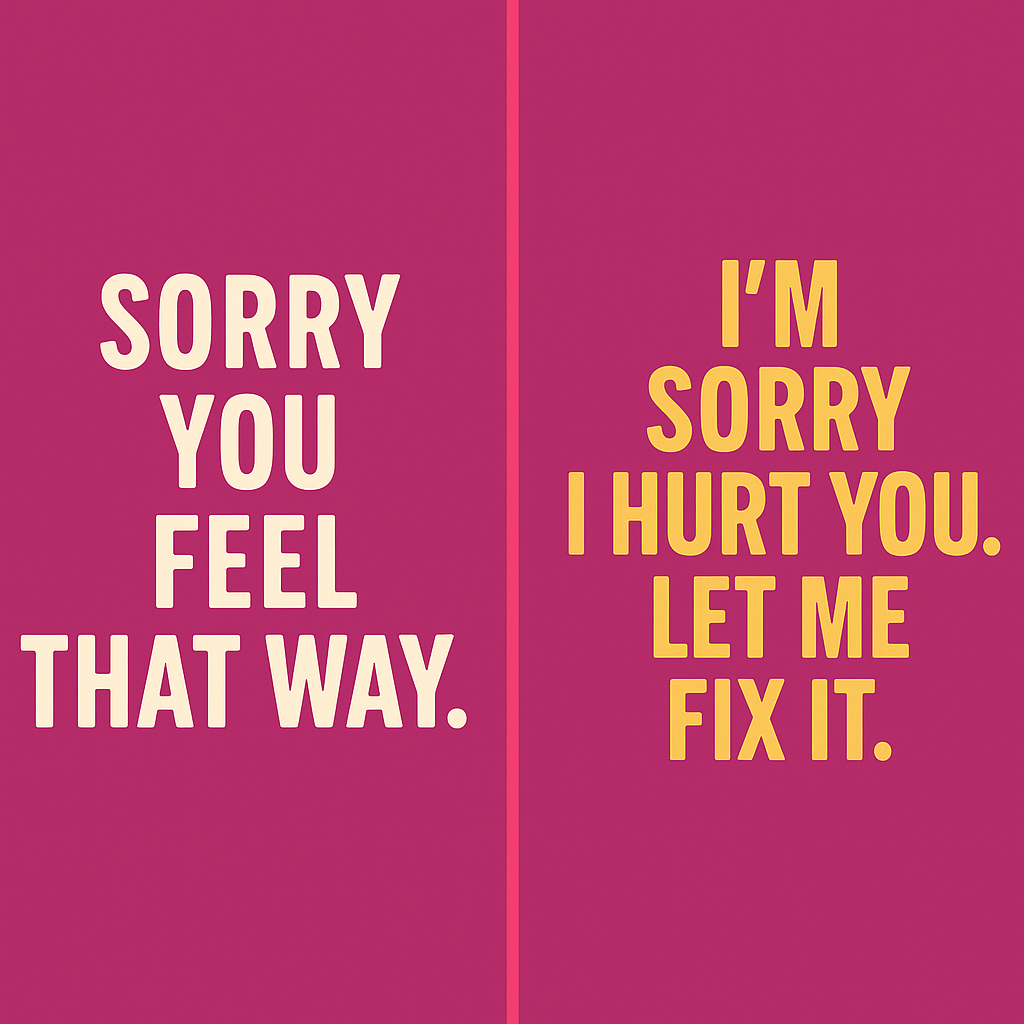
- Defensiveness disguised as empathy: “I’m sorry you feel that way.”
- Blame-shifting: “I wouldn’t have said that if you hadn’t…”
- Vagueness: “Sorry for…whatever I did?”
- Overcompensation: Sending flowers instead of facing the conversation.
These are performative. They’re about escaping discomfort, not repairing harm. And they leave the other person holding emotional baggage you dropped on them and never picked back up.
So What Is a Real Apology?
According to a 2025 article from The Guardian, researchers have broken down the science of a meaningful apology, and it’s not about groveling—it’s about repair.
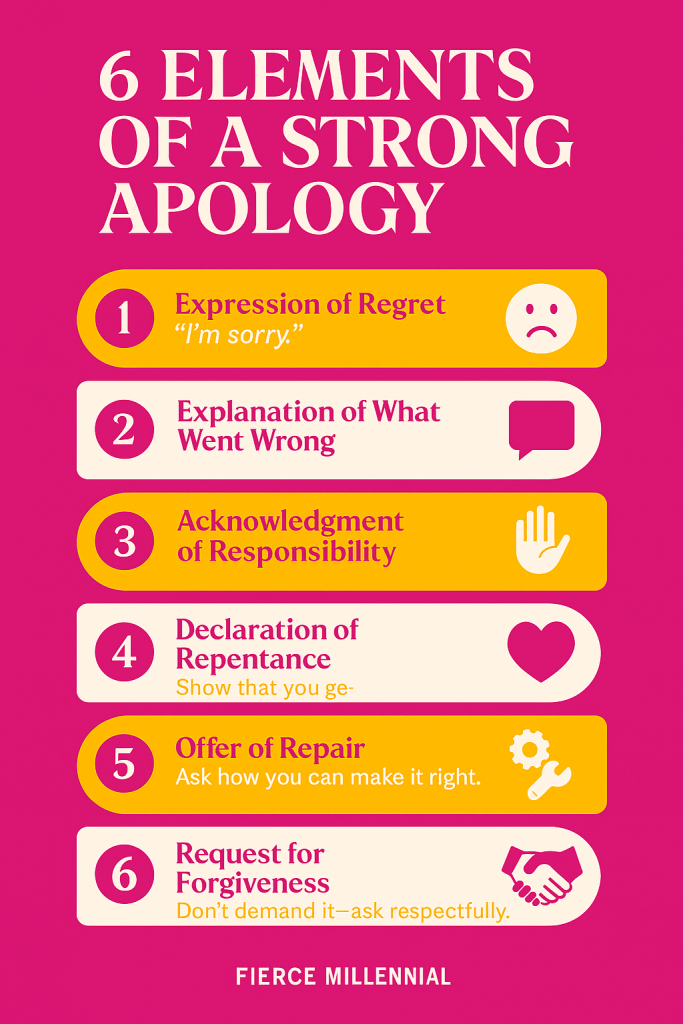
A real apology has six core elements, and skipping any one of them could sabotage the outcome:
1. Expression of regret – A clear, sincere “I’m sorry.”
2. Explanation of what went wrong – Not an excuse, just an honest acknowledgment.
3. Acknowledgment of responsibility – No “buts,” just “I did this.”
4. Declaration of repentance – Making it clear you wish you hadn’t.
5. Offer of repair – “How can I make this right?”
6. Request for forgiveness – Not demanded, but gently offered.
You don’t have to say all six things word-for-word like a script, but the energy has to be there. Because real apologies take vulnerability. And vulnerability is the cost of closeness.
Why It Matters More as We Get Older
Let’s be real—friendships get more fragile in your 30s and 40s. Not because people are more sensitive, but because we’re tired. Tired of fake accountability. Tired of patterns that don’t change. Tired of showing up for people who disappear when they’re the ones in the wrong.
The stakes are higher now. We’re not in college where you could argue, ghost, and show up like nothing happened. People are choosing peace over proximity. They’re cutting off parents, blocking exes, quitting jobs, and walking away from longtime friends over unacknowledged harm. And sometimes? They’re right to.
But that means the people willing to apologize with sincerity become rare and sacred. Be one of those people.
The “Sorry” That Changed My Life
Let me tell you about the best apology I ever got.
It wasn’t fancy. No big speech. No gift card. Just a voice message from a longtime friend that said:
“Hey. I thought about what you said. You were right. I got defensive and that wasn’t fair to you. I’m sorry. I don’t want to lose this friendship, and I’m working on it.”
That was it.
And it healed something deep. Not just because she said she was sorry—but because she meant it. She saw me. She saw what her actions cost. And she didn’t make me fight for that recognition.
You deserve that kind of healing. And you can give it too—if you learn to apologize like you mean it.
Apologizing Doesn’t Make You Weak—It Makes You Fierce
Let’s redefine strength, shall we? Real strength isn’t never being wrong. It’s knowing how to recover when you are. It’s owning the mess, cleaning it up, and learning how not to repeat it.
Whether you’re trying to fix a romantic relationship, hold on to a friendship, or rebuild trust at work, apology is a power move. But only if it’s done with humility and intention—not ego.
If you’re not used to saying sorry, or you grew up in a household where no one modeled that skill, don’t beat yourself up. Learning to apologize is exactly that—a learned skill. And now is as good a time as any to practice.
3 Fierce Ways to Practice Real Apologies
1. Pause Before You React
Feel defensive? That’s your sign to pause, not pounce. Breathe. Listen. Ask: “What did they need that I missed?”
2. Get Specific
“I’m sorry I dismissed your feelings when you needed support” hits way harder than “Sorry for being mean.”
3. Follow Through
Don’t say sorry and then act the same. Real apologies are paired with changed behavior, or else it’s just manipulation in a trench coat.
Final Thought: Do It Before It’s Too Late
So ask yourself: how sorry are you—really?
You don’t have to apologize for who you are. But you do need to apologize when what you’ve done hurts someone else. That’s not weakness—it’s emotional fluency. And in this wild world where everyone’s carrying old wounds and new boundaries, a well-crafted apology can mean the difference between healing and heartbreak.



 Fierce Millenial
Leave a comment